








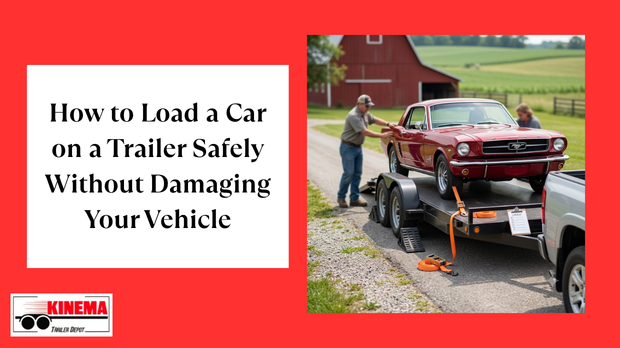
If you have never done it before, loading a car onto a trailer safely can be daunting. The process, however, is simple and requires some vehicle straps and ratchets. Use tire straps if you have a modern, small car. Alternatively, if you have a large car or a model made before 1990, then use axle straps.
Here’s the complete procedure on how to load a car on a trailer without damaging it.
Car Trailer Loading Tips
Bring your trailer to a flat patch of ground. You mustn’t use slanted areas, such as driveways, because they could compromise safety. Place wheel chocks against the tires.
For trailers specifically designed for towing cars, use the two heavy-duty ramps that come with them. Pull them out and check if they are parallel.
For a trailer without a built-in ramp, purchase one from any auto supply store and connect it. Makeshift ramps are not advisable.
Bring the car you are towing to level up behind the trailer and line its wheels up with the trailer ramps. Accelerate slowly onto the trailer until its weight is distributed across the trailer’s surface. Check if it is centered on the trailer. The car should be on the parking brake, or if you have a manual car, set it on the handbrake.
Securing the Car
Small modern vehicles can be secured with tire straps. Keep the car steady, and when attached correctly, the straps don’t damage your car.
Tire straps don’t fit vehicles with large tires.
Pull the end of the lasso strap and wrap it around the car’s front left tire. The strap should cover the hubcap. Then thread it through the ratchet strap, pull the exposed end through the hole of the ratchet strap buckle, leaving some slack. Connect the straps as you crank the ratchet’s handle 3 or 4 times. Then look for the trailer’s D-ring and hook one end of the ratchet strap into it. Tighten the straps and double-check if they are secure and not in contact with the car’s body. The process should be repeated with each wheel.
Must Read: How to Load a Trailer Correctly in 5 Simple Steps for Safe Towing
Axle Straps
Larger or older vehicles need axle straps to keep the vehicle in place. This is particularly because axle straps can cause damage to modern and smaller vehicles. Wrap the axle strap around the car’s rear axle bar, then secure it by closing the metal clip. Thereafter, connect and clip the ratchet strap to the trailer’s D-ring. Tug it to make sure it is secure. Pull the other free end of the ratchet strap through the buckle center, leaving some slack. Then lock the strap in place by raising and lowering the ratchet’s handle 3 or 4 times.
Don’t overtighten the straps. It could lead to axle damage.
Repeat the process on the right side with the second axle and ratchet strap.
Checking for the Car’s Safety
Attach the trailer’s safety chain to the front of the car. For this, you may have to pull the chain around the A-arm of your car and twist it to clip it onto the chain loop. Don’t tighten the chain. Just attach it. This holds the car in place if the straps were to break.
Now check if the straps are tight and holding down like they are supposed to and not crushing the oil lines, brakes or the car’s body. Secure and stow the ramps.
It’s now time to test drive your trailer.
Drive through a slow, quiet neighborhood or an empty parking lot to make sure your car is secure. After driving for about 10 to 25 miles, adjust the straps again and reposition them if required. In fact, it is advisable that whenever you stop for food or fuel, you inspect the straps and ensure your trailer is safe.
For more such informational Articles follow Kinema Trailer Depot.
FAQs
Q1. Where can I safely load a car onto a trailer?
Always navigate to a flat surface or level ground, and slowly drive the car up on the ramp centered on the trailer.
Q2. When should I use axle straps?
If your vehicle is large with big tires or is an older model, then it is best to use axle straps.
Q3. Is tightening the straps advisable?
While tightening the straps is advisable, overtightening them can damage the vehicle and its axles.
Q4. Are safety chains necessary when transporting a car?
Yes. Safety chains provide an additional layer of protection if the straps fail.
Q5. Should I check the straps consistently during transport?
Yes. Whenever you stop for food or fuel, make sure you check the straps.
About Author: