








Towing can get rough if you don’t know your hitch’s weight rating. While it directly impacts your car, you are also at risk of serious accidents and personal injury when you use the wrong hitch. Here’s what you should know about hitches and the advantages of the class 2 trailer hitch in particular.
Hitch Weight Rating
The maximum weight a hitch can carry safely is called the hitch weight rating. This is broken down into two parts: the GTW (Gross Trailer Weight), which is the combined weight of the cargo and the trailer, and the TW (Tongue Weight), the downward pressure applied to the hitch by the trailer’s coupler. The load a hitch can pull and support is determined by its specific weight rating. Additionally, the rating is designated by the manufacturer based on the hitch’s design, the materials used during production, and the mounting points on the vehicle.
It can be highly stressful when you have to haul your camper for the first time. But when you understand the actual towing weight and install the right hitch, it gets easier. That is why it is extremely important to understand every aspect of your towing setup.
Parts of a Receiver Hitch
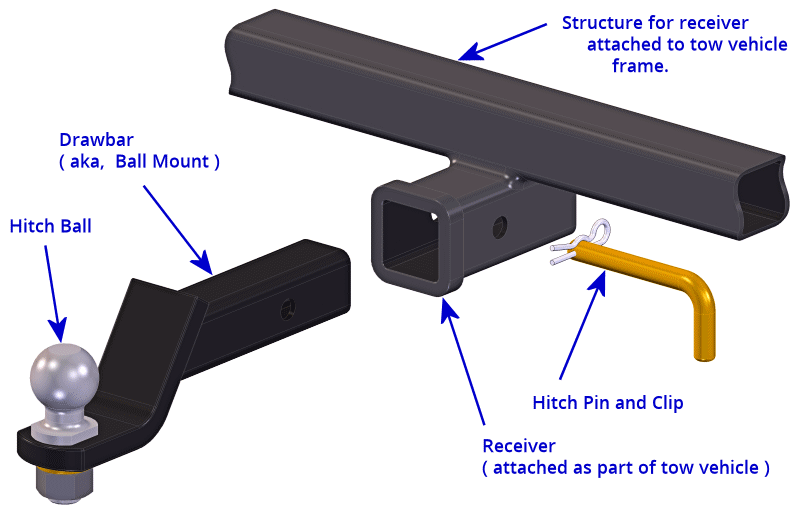
Main Body
The foundation of the trailer hitch system, the main body, is fitted directly into your vehicle’s frame. Made from steel it features a black powder coat finish and liquid A-coat.
Brackets
The mounting brackets are attached to your vehicle. You can choose a hitch that is tailor-made to the make, year and model of your vehicle. This way, you can securely attach the hitch, and the entire design ensures a proper fit. You don’t have to worry about securing it with additional bolts and nuts.
Receiver
An essential and important part of towing, this is the primary connection that attaches the cargo rack, ball mount and other accessories. There are five classes of receiver hitches. Each of these has a disparate towing capacity and receiver tube size. The higher the class, the greater the weight capacity and receiver size.
Important Tip: Not all classes will fit all vehicles. You must check the manufacturer’s guidelines or the owner’s manual for the best fit for you.
Pin Hole
To keep the ball mount and accessories from sliding out during use, you need a pin hole, which is an essential safety feature. You will need the easy-to-use pin and clip, which are vital components to quickly attach or remove your ball mount and accessories.
Anchors
Safety chain anchors are critical backup connections between the towing vehicle and the trailer. Safety chains are meant to keep your trailer attached in case the hitch encounters a failure. Thus, it prevents the trailer from becoming a runaway hazard.
Must Read: Class 2 Trailer Hitch vs Class 3
Receiver Sizes
The seamlessness of your towing depends on whether you have chosen the right receiver hitch. Using the appropriate receiver hitch maximizes towing capacity and safety. For instance, when you choose the class 2 hitch receiver, consider your vehicle’s towing capacity and the type of load you’d be carrying.
Weight Rating
When it comes to towing, it is always better to be safe. The vehicle and the hitch system must be rated for compatibility for whatever cargo you are hauling. To determine the maximum load your hitch can handle, it is crucial to know its weight ratings.
Gross Trailer Weight (GTW)
The maximum allowed weight on a fully loaded trailer is the GTW, gross trailer weight. This includes the trailer’s weight plus the cargo and accessories loaded onto it. Exceeding the GTW could stress the hitch and the towing vehicle and could lead to unsafe driving and mechanical failures. Don’t overstretch the vehicle’s towing capacity to achieve towing stability and to prevent accidents.
Must Read: Top 10 Trailer Dealers in Georgia (2026 Update)
Tongue Weight (TW)
The downward pressure exerted on the hitch ball of the towing vehicle is called tongue weight. Understand TW to ensure trailer balance and appropriate handling. It also comes with a rating indicating the maximum weight the hitch ball can support. Make sure the trailer and towing vehicle are aligned and manage weight appropriately, while preventing vehicle sway.
Hitch Classes
Typically, hitches are classified as class 1, class 2, class 3, and so on. For efficient towing, learn and understand the capacity and strength behind each hitch class. You can achieve optimal performance and safety on your journey when you choose the right hitch.
All About Class 2 Trailer Hitches
- Haul capacity or GTW is 3,500 lbs.
- Maximum tongue weight is 200 lbs.
- Two smaller SUVs, minivans, etc., with the 1-1/4 receiver.
- Class 2 hitches can also be vehicle-specific
- When custom-made, these are highly ideal for towing.
- You can expect a dependable performance and elevate everyday flexibility of hauling when these are tailor-fit and precision-welded.
- These are usually installed on full-size pickups, SUVs and vans, and tow small recreational campers and vehicles.
- The class 2 hitch is the second-lightest hitch available on the market.
- For any information you need about Class 2 hitches, call our experts today.
FAQs
Q1. What is the hitch weight rating?
The maximum weight a hitch can carry safely is called the hitch weight rating, which is further broken down into GTW (Gross Trailer Weight) and TW (Tongue Weight).
Q2. How many hitch classes are there?
There are five hitch classes in total.
Q3. Why do I need to use the appropriate receiver size?
To avoid accidents and swaying, it is extremely important to use the appropriate receiver size.
Q4. What is the weight capacity of a Class 2 tow hitch?
Class 2 hitches’ towing capacity is about 3,500 lbs with a maximum tongue weight of 200 lbs.
Q5. Where can I call if I am facing a difficulty with my hitch?
You can always reach out to experts at Kinema Trailer Depot LLC if you need any more information.
About Author: