








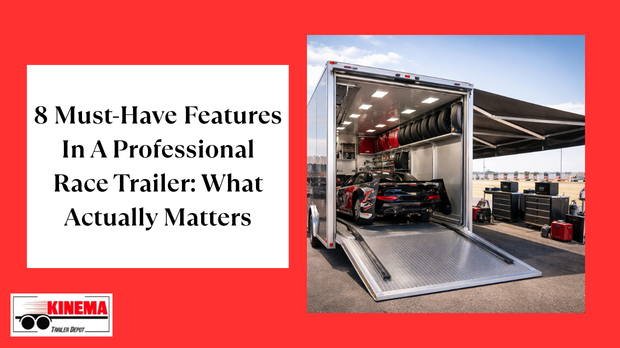
I learned what a race trailer really needs the hard way—bought my first enclosed trailer six years ago for $9,500 off Craigslist. Twenty-footer, decent shape, figured it was perfect for hauling my dirt late model to tracks around the Midwest.
First race weekend at I-80 Speedway in Nebraska, I realized I’d bought a glorified metal box on wheels.
No living space, so I slept in my truck. No organized storage, so I spent twenty minutes digging through totes for a single wrench. No work lights, so I changed a shock in the dark using my phone flashlight. No climate control, so I roasted during the day and froze at night.
I finished the season but knew I needed better. Spent the next two years watching what successful teams actually used. Talked to guys running regional tours, national series, and even some NASCAR guys at bigger tracks.
The difference between a basic trailer and a professional setup isn’t just money—it’s functionality that directly impacts your performance and quality of life at the track.
Here are the eight features that actually matter if you’re serious about racing.
1. Living Quarters That Don’t Suck
Most weekends, you’re at the track from Thursday or Friday through Sunday. That’s three to four nights.
Hotels near popular tracks get expensive fast—$120-$180 per night adds up to $500+ per weekend. Multiply that by a 20-race season, and you’re spending $10,000 just on hotels.
What you actually need:
A proper sleeping area. Not a shelf, a real bed or convertible dinette. You need sleep to think clearly when you’re tuning a car.
Kitchen basics. Microwave, mini fridge, sink. You’re not cooking five-course meals, but being able to heat food and store drinks beats fast food three times daily.
A real bathroom. Not a porta-potty situation. Shower, toilet, sink. After a dusty day at a dirt track, you actually need to clean up.
Climate control that works. AC for southern summer races, heat for early season or late season cold.
My current trailer has all this in an 8-foot living section. Simple setup—dinette converts to a bed, compact bathroom, small kitchen along one wall. Cost me an extra $6,500 over a cargo-only trailer, but saved me thousands in hotel costs the first season alone.
Plus, I’m at the track whenever I need to be. No driving back and forth. No missing late-night driver meetings. No rushing in the morning.
2. Tie-Downs That Actually Secure Your Car
Your racecar is worth more than most people’s daily drivers. Mine’s around $45,000 in parts and labor. It needs to be secured properly.
I’ve seen cars shift during transport. A buddy of mine hit his brakes hard on the highway, and his sprint car slid forward six inches despite being “tied down.” Bent the front suspension mounting tabs. Cost him $1,800 to fix, plus he missed that weekend’s race.
What actually works:
D-rings or E-track recessed into the floor at reinforced mounting points. Not just bolted to sheet metal that’ll rip out.
Four minimum tie-down points—two front, two rear. Six is better for low, wide cars.
Quality ratchet straps rated for at least 3,000-pound working load. Not the cheap ones from hardware stores.
Wheel chocks front and rear. Every single time you load.
I use a six-point system on my late model. Takes an extra five minutes to strap in, but I’ve hauled that car 40,000+ miles over four years without a single shift or damage incident.
3. Storage That Actually Makes Sense
Race teams bring ridiculous amounts of stuff. My late model program includes:
- Two full toolboxes
- 12-16 tires, depending on track
- Spare shocks, springs, and suspension parts
- Body panels and nose pieces
- Engine parts and fluids
- Safety equipment
- Cleaning supplies
Throwing all this into totes and hoping you remember where things are is amateur hour.
What pros actually use:
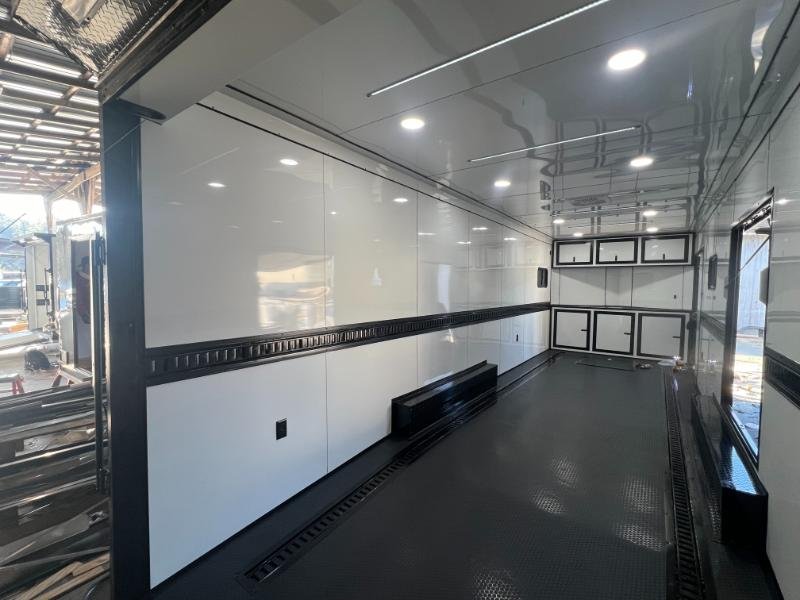
Aluminum cabinets with real latching doors mounted securely to the walls. Not flimsy closet organizers.
Tire racks that hold tires vertically. Saves floor space and keeps tires from getting damaged.
Small parts bins with dividers: all your nuts, bolts, clips, and small components are organized by size.
Tool organization—pegboard, magnetic strips, or foam cutouts. When you need a specific wrench during a thrash, you grab it in two seconds.
I spent $2,200 building custom storage into my trailer. Aluminum cabinets along both walls, a tire rack at the front, and a pegboard over my workbench. Best money I spent. I can find any part or tool without thinking. My crew can too, which matters when you’ve got helpers who aren’t familiar with your setup.
4. Lighting You Can Actually See By
Race tracks have terrible lighting, if they have lighting at all.
I’ve changed transmissions at 11 pm using a headlamp and tried to diagnose a carburetor issue at 6 am before practice with barely enough light to see the engine. Totally missed a cracked motor mount once because I couldn’t see it in the shadows.
What you need:
LED strip lighting runs the entire ceiling length—minimum 3,000 lumens for a 24-foot trailer.
Task lighting over workbenches and areas where you do detail work.
Exterior lights so you can work in the paddock at night.
Battery backup or lights that run off your truck when the generator isn’t on.
I installed a full LED system in my trailer—ceiling strips, under-cabinet lights, and exterior floods. The total cost was $650 in materials. I did the wiring myself. Now I can see everything, anytime, without squinting or using a flashlight.
Changed a rear axle at 10 pm last season with perfect lighting. Had the car ready for the next day’s feature. Without good lights, I’d have been screwed.
5. Climate Control That Works
If you haven’t worked inside a metal trailer in July at a track in Texas or Oklahoma, you don’t understand why this matters.
The trailer becomes an oven. It hits 130°F inside. You can’t breathe. You definitely can’t focus on precision mechanical work.
Then there’s the other end—Wisconsin in April, Iowa in October. It’s 35°F, and you’re trying to adjust the suspension with numb fingers.
What actually works:
Roof-mount AC unit rated for your trailer size. Mine’s a 13,500 BTU system for my 28-footer.
Propane or electric heat for cold weather.
Insulated walls and ceiling. Not just bare metal. Real insulation makes the AC and heat way more effective.
Roof vents for air circulation, even when the AC isn’t running.
My climate control setup cost about $3,800 installed. I can work comfortably in any weather. My crew isn’t miserable. We make better decisions because we’re not fighting heat exhaustion or freezing.
Plus, it protects electronics and data systems from temperature extremes.
6. Power That Doesn’t Quit
Modern race programs run on electricity. Laptops for data analysis, battery chargers, air compressors, impact guns, lighting, climate control, phone charging, literally everything.
You need power, and you need it reliably.
What serious teams run:
Built-in generator. Mine’s a 6,500-watt unit that runs on propane. Quieter than gas, cleaner, and fuel stores indefinitely.
Shore power hookup so you can plug into track power when available.
The circuit breaker panel is distributing power properly.
Multiple outlets throughout the trailer—not just one extension cord running everywhere.
Battery charging system for cordless tools.
My generator setup cost $4,200 installed. Dual-fuel (propane and gas) for flexibility. Runs everything I need, including AC when it’s hot.
Some tracks have power; most don’t. Generator means I’m never dependent on track facilities.
7. Workspace You Can Actually Use
The car needs to fit in the trailer with room to work around it. Plenty of guys buy trailers where the car barely fits, with zero workspace.
What you need:
Minimum two feet of clearance around the vehicle when it’s loaded. Three feet is better.
Fold-down workbench that doesn’t interfere with car loading.
Floor space for a rolling toolbox and floor jack.
Non-slip flooring that cleans easily. Diamond plate, aluminum, or rubberized surface.
My 28-foot trailer has about four feet of workspace behind my car when it’s loaded. I can work on the rear suspension, change rear gears, and swap shocks, all inside the trailer in bad weather.
The workbench folds up when I’m loading or unloading, and folds down when I need a surface for parts layout or laptop work.
Can’t do serious work in a cramped trailer. You’ll hurt yourself or damage something.
8. Awning and External Setup
Most race work happens outside in the paddock, not inside the trailer.
You need shade from the sun. Cover from rain. Exterior power for pit equipment—external storage for frequently-used items.
What works:
Pull-out awning that extends at least 10 feet. Provides coverage for crew and quick repairs.
Exterior lighting for night work in the paddock.
Exterior power outlets that run off your generator or shore power.
External storage boxes for fuel cans, jack stands, and pit equipment you don’t want inside.
Stabilizer jacks so the trailer doesn’t rock when people are moving around inside.
My awning extends 12 feet and covers about 300 square feet. Cost $1,800 installed. We set up chairs, coolers, and a work area underneath. Stay out of the sun, stay dry in the rain, and have room for the crew to hang out between races.
External lighting means we can work outside at night when needed. External outlets power air compressors and tools without running cords through the trailer door.
What I’d Build If I Started Over
If I were buying a race trailer today, knowing what I know now, here’s what I’d get:
28-32 foot enclosed trailer with 8-foot living quarters in the front. Living space includes a bed, a bathroom with a shower, a small kitchen, and climate control.
Remaining 20-24 feet for the car and workspace. Aluminum cabinets along both walls, tire racks, and organized storage.
Full LED lighting system inside and out.
6,500-watt generator, shore power capability, proper electrical panel.
13,500 BTU AC and propane heat.
Pull-out awning with exterior lighting.
Proper tie-down system with six D-rings.
Fold-down workbench and non-slip flooring.
Budget for this setup is new: $50,000-$65,000, depending on options and who builds it.
Budget for used trailer with upgrades: $25,000-$35,000 if you find the right one and do some work yourself.
I’m into my current setup for about $38,000 total—bought the trailer used for $24,000, added $14,000 in upgrades over two seasons. It’s been worth every penny.
The Bottom Line
You can race out of a basic cargo trailer. Plenty of guys do. But if you’re traveling to multiple tracks, running a serious program, or spending entire weekends at the track, these eight features stop being luxuries and start being necessities.
- Living quarters save you money and keep you on track when you need to be there.
2. Proper tie-downs protect your investment.
3. Organized storage saves time and frustration.
4. Good lighting prevents mistakes and injuries.
5. Climate control keeps you comfortable and focused.
6. Reliable power runs everything you need.
7. Adequate workspace lets you actually fix things.
8. External setup makes paddock life workable.
My first season with a basic trailer was miserable. My last four seasons with a proper setup have been completely different. I show up prepared, work efficiently, stay comfortable, and focus on racing instead of fighting my equipment.
The trailer isn’t just transportation—it’s your mobile shop, your pit area, your living space, and your team headquarters rolled into one.
Build it right, and it becomes your biggest competitive advantage off the track.
About Author: