








My cousin bought a mobile kitchen trailer in Alberta last year.”How much?” I asked when he sent me photos. “$42,000.” I nearly choked on my coffee. “For a trailer?!”
He laughed. “Wait until you see it.”
He sent more photos. Full commercial kitchen setup, three-compartment sink, hood system, propane griddle, fryer, fridge, freezer, generator, hot water tank. The thing was nicer than some restaurant kitchens I’ve eaten in.
Then he explained the business. He does catering for corporate events, weddings, and festivals across Southern Alberta. That trailer generates $15,000-20,000 monthly in revenue during the busy season. It paid for itself in less than two years.
Suddenly, $42,000 didn’t seem so crazy.
I’ve since talked to probably a dozen mobile food vendors across Canada, from Toronto food truck owners to BC food cart operators to Saskatchewan festival vendors. The pricing is all over the map, and understanding why costs what it does can save you from massive mistakes.
Let me break down what actually impacts mobile kitchen trailer pricing in the Canadian market.
The Base Trailer Cost (Your Foundation)
Before you even think about kitchen equipment, you’re starting with the trailer itself.
Basic enclosed cargo trailers: $8,000-$15,000 for a 16-20 foot trailer
This is just a bare aluminium or steel enclosed trailer with a side door and a rear door. No kitchen equipment at all. You’re buying the rolling box that you’ll convert into a mobile kitchen.
I talked to a guy in Winnipeg who bought a basic 18-foot enclosed cargo trailer for $11,500—spent another $28,000 converting it into a mobile kitchen—total investment: $39,500.
Purpose-built food trailers: $15,000-$25,000 for the same size
These come pre-wired with proper electrical, pre-plumbed for water systems, insulated properly, and with reinforced floors for heavy equipment. They’re designed from the ground up for food service.
More expensive upfront, but they save you conversion headaches. The electrical is already run to code. The floor can handle a 400-pound fryer. The walls are insulated properly for Canadian winters.
Custom-built trailers: $20,000-$35,000+ before equipment
If you need specific dimensions, multiple service windows, a custom layout, or special features, you’re looking at custom fabrication.
A food vendor in Ottawa had a 24-foot trailer custom-built with three service windows and a walk-in prep area. The trailer alone was $29,000 before any kitchen equipment.
Size matters too. An 8×16 costs way less than an 8×24. Every extra foot adds $800-1,500 to the base price.
Here’s what impacts equipment costs:
New vs. used: Used commercial equipment saves money, but you need to know what you’re buying. A used fryer might save you $800, but if it breaks in six months, you’ve lost money and business.
Brand matters: Commercial kitchen brands like Vulcan, Garland, and True cost more, but they’re built to handle constant use. Cheaper residential-grade equipment fails under commercial workload.
Features and capacity: A basic griddle costs $1,200. A griddle with multiple heat zones, thermostatic controls, and a larger surface area? $3,500. Do you need those features? Depends on your menu.
Electrical Systems (Can’t Cheap Out Here)
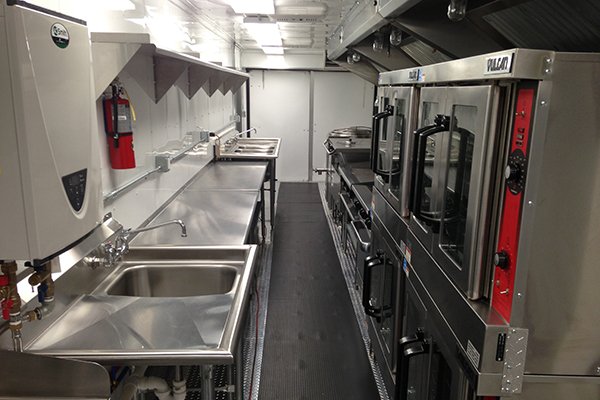
Mobile kitchens need serious electrical capacity. This isn’t plugging a toaster into a wall outlet.
Basic electrical setup: $2,000-$4,000
This gets you:
- Proper wiring to code
- Breaker panel
- Outlets in the right places
- Shore power connection (to plug into venue power)
- Basic lighting
Mid-level setup: $4,000-$7,000
Adds:
- Generator with auto-transfer switch
- More sophisticated electrical panel
- Better lighting
- Multiple circuits for heavy equipment
High-end setup: $7,000-$12,000+
Includes:
- Commercial-grade generator
- Backup power systems
- Solar panels (some vendors add these)
- Full LED lighting package
- Multiple independent circuits
Canadian winters make reliable electrical even more critical. You need heat, lighting, and your equipment running reliably at -20°C.
A food vendor in Saskatchewan told me his electrical system cost $8,500 because he needed serious heating capacity for winter festivals. Worth every penny when he’s serving poutine at outdoor Christmas markets in January.
Plumbing and Water Systems (Required, Not Optional)
Every mobile kitchen in Canada needs proper water systems to meet health codes.
Basic system: $1,500-$3,000
- Fresh water tank (30-50 gallons)
- Grey water tank (40-60 gallons)
- Manual pump or small electric pump
- Basic plumbing to sink
Standard system: $3,000-$5,500
- Larger tanks (50-80 gallons fresh, 60-100 gallons grey)
- Electric pump with pressure system
- Hot water tank
- Plumbing to multiple fixtures
Advanced system: $5,500-$9,000+
- Large capacity tanks
- On-demand hot water system
- Multiple sinks and fixtures
- WinterizationWinterization systems
- Water filtration
That winterisation matters in Canada. You can’t have your plumbing freeze at a fall festival in Calgary. Proper insulation and heating for water lines adds $500-$1,500 to your system.
Health Code Compliance (Non-Negotiable Costs)
Different provinces have different requirements, but they all cost money.
Ontario: You need TSSA (Technical Standards and Safety Authority) approval for propane systems. This involves inspections and certifications. Budget $800-$1,500 for compliance.
BC: WorkSafeBC has specific ventilation requirements. Your hood system needs proper makeup air. This can add $1,500-$3,000 to your ventilation costs.
Alberta: Alberta Health Services requires specific handwashing stations separate from food prep sinks. Some vendors need to add an extra sink just for this, adding $600-$1,200.
Quebec: Quebec has some of the strictest food service regulations. Some vendors spend $2,000-$4,000 extra just meeting Quebec-specific requirements.
A food vendor who operates across multiple provinces told me she spent an extra $5,000 making sure her trailer met requirements in Ontario, Quebec, and Manitoba. But that investment lets her book events anywhere in Eastern Canada without worrying about compliance.
Customisation and Features (Where You Make It Yours)
Basic mobile kitchen trailers are functional but boring. Most vendors add custom touches.
Exterior finishes:
- Basic white aluminium: included
- Vinyl wrap with your branding: $2,000-$6,000
- Custom paint job: $3,000-$8,000
Service windows:
- Basic sliding window: $400-$800 each
- Roll-up service window: $1,200-$2,500 each
- Custom window with serving shelf: $1,500-$3,500 each
Interior finishes:
- Basic: stainless steel walls, simple flooring
- Upgraded: tile backsplash, better flooring, better lighting
- Cost difference: $1,500-$4,000
Awnings and canopies: $800-$3,000
Essential for Canadian weather. You need coverage for customers and your service window.
Signage and menu boards: $500-$2,500
Professional-looking menu boards and signage make you look legitimate.
My cousin spent $4,200 on a full vinyl wrap with his logo and menu. Says it’s worth it because people remember his trailer and book him for events.
Regional Pricing Differences Across Canada
Where you buy matters.
Ontario and Quebec: Highest prices. Demand is high, and regulations are strict. A fully equipped mobile kitchen trailer that costs $38,000 in Saskatchewan might run $45,000-$48,000 in Toronto.
Alberta: Mid-range pricing. Good selection of builders. My cousin’s $42,000 trailer would cost $48,000-$50,000 in Vancouver or Toronto.
BC: High prices, especially in the Lower Mainland. Limited builders mean less competition. Expect to pay 10-15% more than in Alberta.
Prairies (Manitoba, Saskatchewan): Best pricing. Lower demand, lower cost of living. You can save $5,000-$8,000 buying in Winnipeg versus Vancouver.
Atlantic provinces: Limited local builders. Many people buy from Ontario or Quebec and have them shipped, which adds $1,500-$4,000 in transport costs.
I know a Nova Scotia vendor who bought his trailer in Ontario and paid $2,800 to have it shipped to Halifax and still saved $3,500 compared to buying locally.
Financing and Hidden Costs
The sticker price isn’t your only cost.
Financing: For most of the banks food trailers are like RVs and commercial equipment, Expect 6-10% interest rates. Over five years, financing a $40,000 trailer costs you $7,000- $12000 in interest rates.
Insurance: Mobile kitchen trailers need commercial insurance. Budget $1,500-$3,500 annually, depending on coverage and province.
Licensing and permits: Business licenses, food handler permits, and mobile vending permits. Its Costs vary wildly by municipality, but budget $500-$2,000 annually.
Commissary kitchen: Some provinces require mobile vendors to have a licensed commissary kitchen for prep work. This can cost $500-$1,500 monthly.
Maintenance and repairs: Budget 5-10% of your trailer’s value annually for maintenance. A $40,000 trailer needs $2,000-$4,000 yearly for upkeep.
What You Actually Need vs. What’s Nice to Have
Here’s the hard truth: you can spend $60,000+ on a mobile kitchen trailer. But do you need to?
Essential (can’t operate without these):
- Health code-compliant sinks and plumbing
- Proper ventilation and hood
- Commercial refrigeration
- Cooking equipment for your menu
- Generator or reliable power source
What I’d Do If I Were Buying Today
If I were starting a mobile food business in Canada right now, here’s how I’d approach pricing:
Budget tier: $25,000-$35,000. Buy a used or basic enclosed trailer. Install essential equipment only. DIY what you safely can. Start simple, upgrade as you profit.
Mid-tier: $35,000-$50,000 Buy a purpose-built food trailer. Install good mid-range commercial equipment. Get proper electrical and plumbing. This is the sweet spot for most vendors.
Premium tier: $50,000-$70,000+ Custom trailer, top-tier equipment, all the features. Only makes sense if you’re doing high-volume catering or have secured contracts justifying the investment.
Most successful mobile vendors I’ve talked to started mid-tier. They didn’t cheap out on essentials but didn’t blow money on unnecessary premium features either.
The Bottom Line
Mobile kitchen trailer pricing in Canada ranges from $25,000 to $70,000+, depending on size, equipment, features, and location.
The base trailer is 20-30 % of the total cost. Equipment, electrical, plumbing, and compliance make up the rest.
Don’t cheap out on essentials like proper refrigeration, adequate power, and health code compliance. But don’t overspend on features that don’t directly help you serve customers and make money.
My cousin’s $42,000 trailer seemed expensive until I understood what went into it and how much revenue it generates. Now he has a fair deal for a properly equipped, code-compliant mobile kitchen.
About Author: