








If you spend any time around trailers, whether for work, farming, travel, or transport, you quickly realize that the connection between the trailer and the towing vehicle is one of the most important parts of the entire setup. This connection is called a trailer hookup or trailer hitch system.
While it may look simple from the outside, trailer hookups are carefully designed to handle different trailer weights, road conditions, and towing needs. The type of hookup you choose directly affects safety, stability, towing capacity, and maneuverability.
For example, the hookup used to tow a small utility trailer behind an SUV is very different from the one used to pull a 40-foot commercial trailer behind a semi-truck. Each system is built with a specific purpose in mind.
In this guide, we’ll walk through the most common types of trailer hookups, how they work, where they’re used, and how to choose the right one for your towing setup.
Understanding Types of Trailer Hookups
A trailer hookup is the mechanical connection that links a trailer to a towing vehicle. It transfers the pulling force from the vehicle to the trailer while keeping both aligned and stable on the road.
Most trailer hookup systems include several components:
- Hitch receiver or mounting system
- Coupler or kingpin connection
- Safety chains
- Electrical wiring connector
- Locking mechanism
These components work together to ensure that the trailer remains securely attached during acceleration, braking, turning, and uneven road movement.
Trailer hookups are generally divided into light-duty, medium-duty, and heavy-duty systems, depending on how much weight they can safely tow.
1. Ball Hitch (Receiver Hitch)
The ball hitch is the most widely used trailer hookup system, especially for personal vehicles and light-duty towing.
You will see ball hitches on everything from small utility trailers and campers to boat trailers and cargo haulers.
How It Works
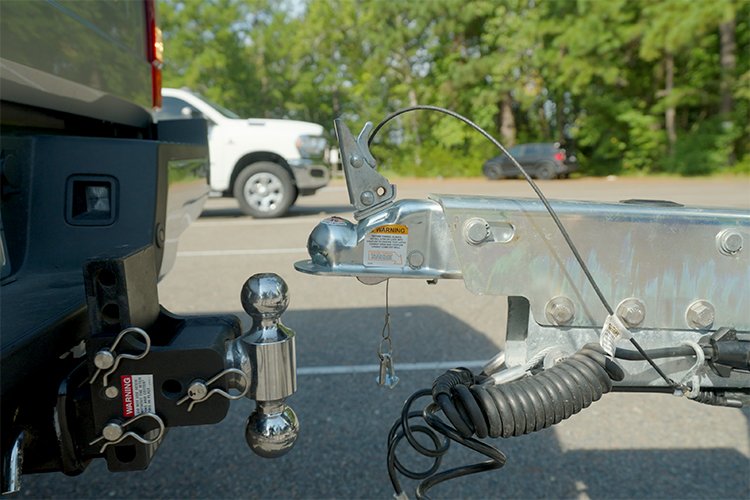
A ball hitch system consists of:
- A receiver hitch mounted on the vehicle frame
- A ball mount that slides into the receiver
- A hitch ball
- A trailer coupler
The coupler on the trailer fits over the hitch ball and locks into place using a clamp-style mechanism.
Once locked, the ball allows the trailer to pivot freely during turns and absorb road movement.
Hitch Classes and Weight Ratings
Ball hitches are divided into classes based on their towing capacity.
| Hitch Class | Typical Capacity | Common Vehicles |
| Class I | Up to 2,000 lbs | Compact cars |
| Class II | Up to 3,500 lbs | Sedans and small SUVs |
| Class III | Up to 8,000 lbs | SUVs and light trucks |
| Class IV | Up to 10,000 lbs | Pickup trucks |
| Class V | Up to 20,000 lbs | Heavy-duty trucks |
Common Uses
Ball hitches are commonly used for:
- Utility trailers
- Small campers
- Boat trailers
- Motorcycle trailers
- Cargo trailers
Advantages
Ball hitches are popular because they are:
- Simple to install
- Affordable
- Widely compatible
- Easy to remove or swap
However, they are not ideal for extremely heavy trailers, where stability becomes more critical.
2. Gooseneck Hitch

The gooseneck hitch is designed for heavy-duty towing, especially when using pickup trucks.
Unlike bumper-mounted hitches, gooseneck systems mount directly inside the bed of the truck, which provides better balance and weight distribution.
How It Works
A gooseneck trailer features a long curved arm (the gooseneck) that extends over the truck bed.
At the end of this arm is a coupler that connects to a hitch ball installed in the truck bed floor.
This design places the trailer weight directly over the truck’s rear axle, which significantly improves towing stability.
Typical Weight Capacity
Gooseneck hitches support typically:
20,000 to 30,000 pounds or more, depending on the truck and hitch design.
Common Uses
You’ll often see gooseneck trailers used for:
- Livestock transport
- Horse trailers
- Flatbed equipment trailers
- Agricultural transport
- Construction equipment hauling
Advantages
Gooseneck hitches provide several important benefits:
- Higher towing capacity
- Improved stability
- Tighter turning radius
- Better weight distribution
Many professional haulers prefer gooseneck setups because they handle heavy loads more smoothly than bumper-style hitches.
3. Fifth-Wheel Hitch
The fifth-wheel hitch is another heavy-duty towing system and is commonly used for large RV trailers and commercial semi-trailers.
It is considered one of the most stable trailer hookup designs available.
How It Works
A fifth-wheel hitch uses a large horseshoe-shaped plate mounted in the bed of a pickup truck or semi-tractor.
The trailer includes a kingpin, which slides into the hitch plate and locks securely in place.
This system allows the trailer to pivot smoothly while maintaining a strong and stable connection.
Typical Weight Capacity
Fifth-wheel hitches can support:
16,000 to 30,000+ pounds
Heavy commercial versions used in semi-trucks can handle even larger loads.
Common Uses
Fifth-wheel hookups are widely used for:
- Large RV campers
- Long-haul trucking trailers
- Heavy cargo trailers
- Car haulers
Advantages
The fifth-wheel system offers several advantages:
- Exceptional towing stability
- Smooth handling on highways
- High weight capacity
- Better control during turns
For people who travel frequently with large RVs, a fifth-wheel hitch is often the preferred setup.
4. Pintle Hitch
The pintle hitch is one of the strongest and most rugged trailer hookup systems available.
It is widely used in construction, military, and industrial towing, where durability matters more than ride comfort.
How It Works
A pintle hitch system includes:
- A pintle hook mounted on the towing vehicle
- A lunette ring attached to the trailer
The lunette ring drops over the hook and locks into place with a latch.
Unlike ball hitches, pintle hitches allow more movement between the trailer and the vehicle, which is useful on rough terrain.
Weight Capacity
Pintle hitches often support:
20,000 to 60,000 pounds, depending on the design.
Common Uses
You’ll often see pintle hitches used with:
- Construction equipment trailers
- Military transport trailers
- Dump trailers
- Heavy industrial trailers
Advantages
Pintle hitches are known for:
- Extreme strength
- Durability in harsh environments
- Ability to handle uneven terrain
The main downside is that they can be loud and less smooth during highway driving.
5. Bumper Pull Hitch

The bumper pull hitch is another common towing setup for light and medium trailers.
This system attaches to the rear bumper or a frame-mounted hitch receiver.
How It Works
The trailer connects to a hitch ball located behind the vehicle, typically just below the bumper.
Because the connection point is behind the rear axle, bumper pull trailers are easier to hook up but may be less stable with heavy loads.
Common Uses
Bumper pull hitches are used for:
- Small campers
- Landscaping trailers
- Utility trailers
- Small cargo haulers
Weight Capacity
Most bumper pull trailers tow up to around 10,000 pounds.
Advantages
They are popular because they are:
- Easy to connect
- Affordable
- Compatible with many vehicles
For occasional towing, bumper pull setups are usually more than sufficient.
6. Weight Distribution Hitch
A weight distribution hitch (WDH) is an accessory system that improves the performance of a standard ball hitch.
It is especially useful when towing heavier travel trailers.
How It Works
A WDH uses spring bars connected to the trailer frame to distribute weight more evenly across:
- The front axle of the tow vehicle
- The rear axle
- The trailer axle
This improves balance and reduces the risk of trailer sway.
Benefits
Weight distribution hitches help with:
- Improved steering control
- Reduced trailer sway
- Better braking stability
- Safer towing of heavy trailers
They are commonly used with travel trailers and campers.
7. Tow Bar Hookup
A tow bar is used when towing one vehicle behind another.
This method is often called flat towing.
How It Works
A tow bar connects the frame of the towed vehicle to the towing vehicle, allowing the towed car’s wheels to remain on the road.
Common Uses
Tow bars are frequently used for:
- Towing cars behind RVs
- Emergency vehicle recovery
- Transporting vehicles short distances
This system is practical but requires proper braking and lighting connections.
How to Choose the Right Trailer Hookup
Selecting the right trailer hookup depends on several factors.
1. Trailer Weight
Always consider the Gross Trailer Weight (GTW) and ensure the hitch rating exceeds that weight.
Using an underrated hitch can be dangerous and illegal.
2. Type of Vehicle
Not every vehicle can support every hitch type.
For example:
- SUVs typically use ball hitches
- Pickup trucks may use gooseneck or fifth-wheel systems
- Semi-trucks use heavy-duty fifth wheels
3. Type of Trailer
Different trailers require different hookups.
Examples include:
- RV campers → Fifth wheel or bumper pull
- Livestock trailers → Gooseneck
- Construction trailers → Pintle hitch
4. Towing Stability
If you regularly tow heavy loads or long trailers, a system that places weight closer to the vehicle’s axle, like a gooseneck or fifth-wheel, will provide better control.
Safety Tips for Trailer Hookups
Regardless of the hitch type, safety should always come first.
Here are a few important practices:
- Always double-check coupler locks before driving
- Use safety chains correctly
- Ensure electrical wiring for brake lights and signals is connected
- Inspect the hitch for wear or damage
- Confirm weight ratings for both the hitch and the vehicle
A properly installed and maintained hitch system can prevent serious accidents and equipment damage.
Final Thoughts
Trailer hookups might seem like a small detail, but they play a major role in towing performance and safety. The right connection ensures that the vehicle and trailer move as a single stable unit, even during sharp turns, sudden stops, or rough road conditions.
For most everyday towing tasks, ball hitches and bumper pull systems are more than adequate. But when the job involves heavy equipment, livestock, or long-distance hauling, systems like gooseneck, fifth-wheel, or pintle hitches provide the strength and stability required.
Understanding the differences between these trailer hookups makes it much easier to choose the right setup for your needs and ensures that every towing job is safe, efficient, and reliable.
FAQs
1. What is a trailer hookup?
A trailer hookup is the connection system used to attach a trailer to a towing vehicle. It typically includes components like a hitch receiver, coupler, safety chains, and electrical connectors. The hookup ensures that the trailer stays securely attached and moves safely with the vehicle during towing.
2. What are the most common types of trailer hookups?
The most common trailer hookups include ball hitches, gooseneck hitches, fifth-wheel hitches, pintle hitches, and bumper pull hitches. Each type is designed for different towing capacities and applications, ranging from small utility trailers to heavy commercial transport trailers.
3. What is the difference between a gooseneck hitch and a fifth-wheel hitch?
Both gooseneck and fifth-wheel hitches are installed in the bed of a pickup truck, but they connect differently. A gooseneck hitch uses a ball connection, while a fifth-wheel hitch uses a kingpin and plate system. Fifth-wheel setups are often used for large RVs and semi-trailers, while goosenecks are popular for livestock and equipment trailers.
4. Which trailer hitch is best for heavy loads?
For heavy loads, gooseneck and fifth-wheel hitches are usually the best choices. These systems place the trailer’s weight over the rear axle of the towing vehicle, providing better balance, higher towing capacity, and improved stability during transport.
5. What is a pintle hitch used for?
A pintle hitch is a heavy-duty towing system commonly used in construction, military, and industrial applications. It connects a lunette ring on the trailer to a hook on the towing vehicle, allowing greater flexibility for towing on rough or uneven terrain.
6. How do I know which trailer hitch class I need?
The right hitch class depends on the gross trailer weight (GTW) and the towing capacity of your vehicle. Light-duty trailers typically use Class I or II hitches, while larger trailers require Class III, IV, or V hitches for safe towing.
7. What is a bumper pull trailer?
A bumper pull trailer attaches to a hitch ball located near the rear bumper of a vehicle. It is one of the most common towing setups and is often used for utility trailers, small campers, landscaping trailers, and cargo haulers.
8. What does a weight distribution hitch do?
A weight distribution hitch improves towing stability by spreading the trailer’s weight evenly across the tow vehicle’s front and rear axles as well as the trailer axle. This helps reduce trailer sway and improves steering control.
9. Are trailer hookups universal?
Trailer hookups are not completely universal. Different trailers require specific hitch types, ball sizes, and weight ratings. It’s important to match the hitch system with both the trailer coupler size and the towing capacity of the vehicle.
10. Is it safe to tow a trailer without safety chains?
No, it is not safe or legal in most regions to tow a trailer without safety chains. Safety chains act as a backup connection in case the primary hitch fails, helping keep the trailer attached to the vehicle and preventing serious accidents.
About Author: