








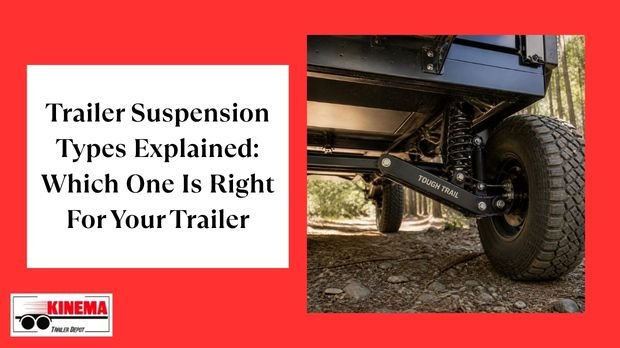
When buying a trailer, many buyers concentrate on the axle configuration, payload capacity, or even cargo limits. But most people don’t realize that the suspension system is an important part of the equation. A poor suspension system can directly affect cargo protection, tire wear, the trailer’s lifespan, and, most importantly, the vehicle’s stability.
Whatever your trailer type, choosing the right suspension system is extremely important. Throughout the trailer’s life, the right suspension system can save you a lot of money on maintenance and tire replacement.
In this trailer suspension guide, you will learn all about the different trailer suspension systems and which one could be right for your trailer.
Reach out to experts at Kinema Trailers to choose the right trailer with solid suspension systems that can last a lifetime.
The suspension system of the trailer
The trailer suspension links the trailer frame to the axles to cushion shocks and vibrations and distribute weight evenly across the trailer. A good suspension structure keeps the tires on the road surface for better braking and stability.
Modern trailers run under different conditions. Trailers need a strong suspension system to handle heavy vibration and protect cargo, whether they are working on rough construction sites, smooth highways, or mining roads. This also reduces tire wear and avoids additional stress on the trailer frame.
Poor suspension can reduce tire life by at least 20% and significantly increase maintenance costs.
Trailer Suspension Types
Modern commercial trailers come with various suspension systems. Depending on the operating environment, each trailer suspension type offers different advantages.
1. Leaf Spring Trailer Suspension
The most traditional and common leaf spring trailer suspension system consists of stacked leaf springs made of hardened steel. They are mounted to the trailer axles and frame. The springs provide cushioning by flexing when the trailer hits bumps or other road irregularities.
Benefits
- Durable
- Cost-effective
- Simple design
- Reliable
- Easy to maintain and repair
- Individual leaf springs can be replaced.
2. Torsion Axle Trailer Suspension
Also called rubber torsion suspension, torsion axle trailer suspension is commonly used on light and small trailers. The suspension uses a rubberized axle assembly instead of leaf springs, improving stability, minimizing bounce, and allowing independent wheel movement.
Benefits
- Excellent shock-absorbing capacity
- Smooth rides
- Each wheel has an independent suspension.
- Compared to leaf spring systems, this requires less maintenance.
3. Air Suspension Systems
Typically found on commercial and heavy-duty trailers, air suspension systems use air springs that can be adjusted to accommodate different road and load types, while supporting the trailer’s weight.
Benefits
- Excellent capacity to carry loads
- Ride height can be adjusted to various conditions.
- Improved ride stability and comfort
4. Rubber Suspension Systems
Used by specialty trailers such as livestock carriers and horse trailers, rubber suspension systems use rubber elements to absorb shocks and provide smooth rides.
Benefits:
- Exceptional shock-absorbing abilities
- Reduced road noise
- Minimized vibration
- Low maintenance
5. Independent Trailer Suspension System
Found primarily on premium trailers, independent trailer suspension systems are meant for horse trailers and high-end travel trailers. Each wheel moves independently, giving better traction and a smoother ride.
Benefits:
- Good stability on bumpy terrain
- Reduced swaying of the trailer
- Comfortable ride
Choosing the Right Suspension System
When choosing your trailer’s suspension system, consider your budget, your needs, and the type of cargo you need to load. Take into account road conditions, ride quality, and weight capacity before buying a system. The system will require regular maintenance and appropriate loading on the trailer. This is, however, regardless of your choice of suspension system. The trailer’s suspension features determine its life and reliability. These are critical to any trailer design, influence smooth operation, and ensure safety.
Speak to experts at Kinema Trailer Depot to understand the various suspension systems available and make reasoned choices that meet your requirements. The right suspension system makes a big difference on your journey.
FAQs
What exactly are trailer suspension systems?
The trailer frame connects to the axles with a trailer suspension, which absorbs shocks and vibrations. It also improves braking performance and stability and ensures a smooth ride.
What is a leaf spring trailer suspension system?
It is a traditional suspension system used widely, made up of stacked steel leaf springs. These are attached to the trailer axles and frame.
Where are torsion axle trailer suspensions used?
These are primarily used by light and small trailers. They minimize bounce and offer independent wheel movement.
Can independent trailer suspension systems be used for horse trailers?
Yes. These can be used for horse trailers and high-end travel trailers too. They offer a smooth ride and better traction.
Can Kinema Trailer Depot help me choose the right suspension systems?
Yes. You can always speak with our experienced consultants to choose the right trailer first. Then, depending on your usage and weight capacity, we will also guide you to the right suspension systems.
About Author: